(The fourth article of a five part series, written in 2023 and posted on my LinkedIn page, here.)
Moving forward from one reading session to the next.
A few years ago I was coaching some team members of an organisation in a program I used to call Bootcamp. It was an ‘as you are, where you are’ reading and writing for a heterogenous group. The team members had little in common, demographically speaking, beyond the fact that they worked for the same organisation, and were nominated for this training.
The coaching was customised, it was online, over the phone or laptop and email. I worked with each individual in the team, at each one’s own pace, across sessions over a period of some weeks. There were times some of the individuals missed their sessions, or were unable, or unwilling, to tackle coaching assignments. There was always a reason. Some worked in villages and small towns where internet and cell phone signals were a problem, or simply finding the physical space where they could set up a laptop or use the phone without background noise, was a problem.
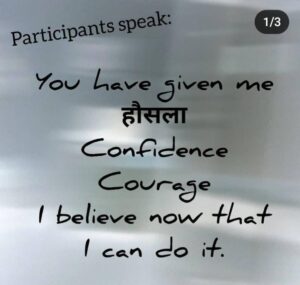
There was one woman, perhaps in her late thirties, possibly early forties, who never missed a single session. We were chatting about this when she laughed and said I need to know where she was on that day, during that session. She’d just finished a meeting with the gram panchayat and was headed out to collect information from an SHG. She’d found a spot where her cell phone worked and called me.
She said that her whole life she’d been afraid of English, though she’d studied the language, but she felt when she saw words in English that they were swimming objects that had no meaning. Until now. She never missed a session because at this bootcamp training she could do things her way, she was bigger than the words, and more important than what she was reading.
I’d have thought running between panchayat office and SHG meetings interfered with reading. That wasn’t it. It was her in relationship to reading, to language, to the impression other people have of her.
Moving forward means different things to different people. I have no prescriptions here for you, but I have suggestions and that have helped me, and that I have collected from people who’ve used them successfully. In offices, in cities, in village school buildings and in company townships cut off from the world both infrastructurally and psychologically.
Most important of all, moving forward requires moving forward. Simple as that sounds, it means you get to it, make space for it, speak up and tell those who need to know that you need to make this space for it. Find your allies and your buddies.
In the previous three articles in this series, I focused on three main themes:-
· The first of these answers this question: Why am I writing a series of articles for professionals on the subject of reading?
· The second answers the Where Do I Begin question. This is a slightly longer article that expands the space to include personal and social contexts. It ends with a list of starting points to approach whatever you are reading. (Or avoiding!)
· The third article presents some reading hacks to help a reader make the most of a single reading session.
This article looks at what to do next.
One thing done, in this case, the first reading session. Assuming that you’ve begun your read, somewhere, either at a place I suggested in this article, or any place you decided you’d like to start.
Many people like to start at the last section, generally called Conclusions. That’s okay, many writers know that conclusions are the only thing a reader will want to read. As a writer, I’ve been there. As a reader too!
Play this game. What if:-
· you, with your particular insights, life experiences and your unique perspective, come to a different understanding, and a different conclusion, from the person who has written what you are avoiding reading?
· the writer is simply incorrect? Those conclusions, in fact a whole lot of ideas and content in what you are trying to read, may be incorrect? One could debate that correct and incorrect depend on perspective. That debate still requires that you respect perspectives, including your own.
Reading ahead is a bit of a tricky thing then, because sometimes it means going back.
Therefore, moving forward
Moving forward is not just about reading the next 3 sentences, paragraphs or pages. Moving forward is about you. Whatever your previous reading session left you with, you want the next level. Here is a suggested 3 step process hack for moving forward from one reading session to the next.
- Don’t look back! Don’t revise anything, don’t look at your notes or words you highlighted.
- Take a decision on what you need to read next, in the now.
· If you are a linear sequence kind of person and began with the first 3 sentences of the first page, read the next 3 sentences.
· If you are a random jumper and like the freedom of leaping around across pages, sections or starting at the end at conclusions, then choose what makes sense to you. If you read the conclusions, you may like to know how the writer made those conclusions. To you, moving forward may mean going back to section 3. Then do this. Read section 3.
- Moving forward is always part of a process. It means there was a starting point and there will be an end point.
· This end point means you have read everything that you need to – whether you did this in an ordered sequence of pages 1 to 10 – or in a disordered sequence of pages 5 to 10, followed by 1 to 4.
· The end point means you covered everything.
Keeping track
How do you keep track of what you read and what matters to you?
- Make notes. I suggest noting the title of what you’re reading, the names of the writers, the organisation (if any) that the writers or the writing comes from, and the date of the writing.
- Note the chapter, the page number, the section, anything you can use to identify later what you have read just now.
- Note the ideas or words that are important to you.
This is you collecting the pieces of the puzzle.
Next: When is it over?