(This article, the second of a five part series, was written in 2023 and posted on my LinkedIn page, here.)
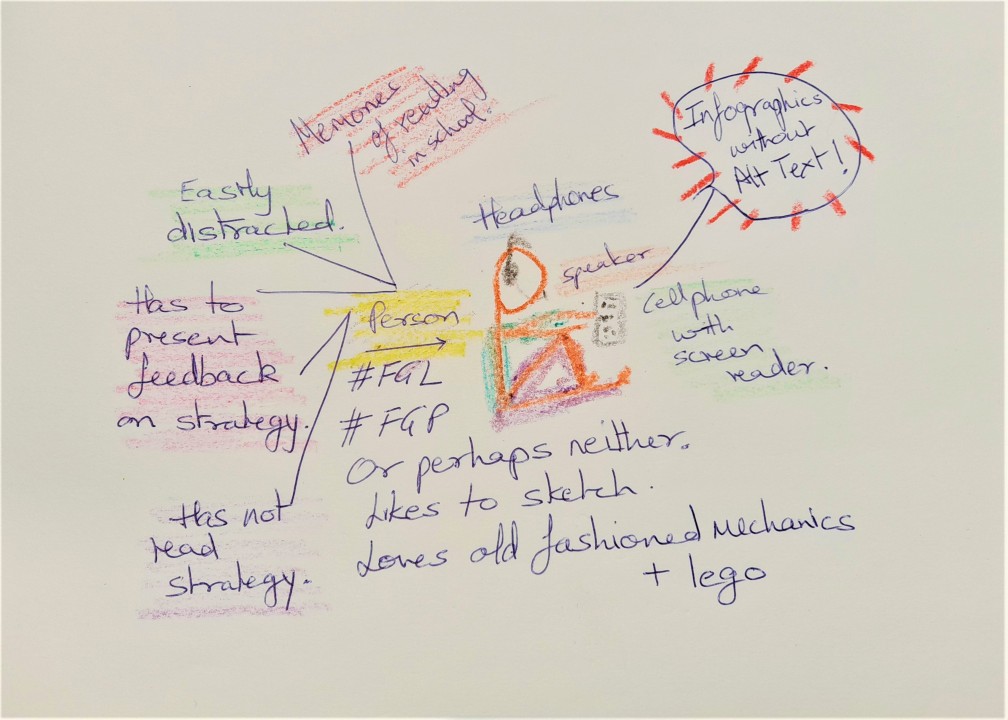
Text surrounding the stick figure in the image above reads: (Right top to bottom) Headphones, Speaker, Infographics without Alt Text! Cellphone with screen reader, Or perhaps neither, Likes to sketch, Loves old fashioned mechanics + lego. (Left top to bottom) Memories of reading in school, Easily distracted, Has to present feedback on strategy, Has not read strategy.
In the previous article in this series, I focused on this: Why am I writing a series of articles for professionals on the subject of reading? My purpose: To support professionals, across sectors, and across job functions and levels who must read, but avoid it.
Begin with your victory dance and #attitude
I don’t know who you are, whether or not you like to dance, can dance, can’t dance. I’m saying, start with your victory thing. Sing, shout, punch the air, comb your hair, put on your shiny t-shirt, order in some idli or momos. Sway from side to side. That’s also good.
For many of us, reading is connected to a world of memories, thoughts and feelings, some good, some embarrassing, some terrifying, and some deeply satisfying. These are a core part of us, very much like the things we like or don’t like eating.
If you are reading this article looking for , then perhaps reading is not your thing. As I have said before, that’s okay. It is also possible that you have reached this paragraph because it reminds you of someone who you think may like to read it.
We all come from different places unique to each of us. Here’s a tiny list that describes some of the people reading this:-
- A friend who grew up in a family that owned a cloth shop in a crowded part of the old town. They were not big on reading.
- The football player in college who dragged me to the library. He explained that he couldn’t read anything that didn’t have pictures in it.
- These friends, and others, who turned out to be great at many things. Except reading.
- I, the writer of this, who grew up in a family of readers with bookshelves lining the walls. I was handed a book to read before I could talk.
I, who love football, cannot play longer than 2 minutes. (10 minutes max, when I was very young.) I, who love money, used to feel challenged by trade and accounts. (I did major work on my attitude to get over this!)
We’ve all got the right to feel our achievements and to enjoy a sense of victory. A defeatist attitude is not and change is the first step here.
Your personal context
As a non-reader, or one who puts off the reading for later, you are not alone.
Some people:
· are shy
· have memories of school where they were humiliated for their lack of reading skills and for mixing up their B’s and D’s
· are bored by the thought of sitting to read
· have grown up in homes where reading was not encouraged, or there was no place to read, or perhaps no time
· have experienced reading as punishment
· have lived through situations where reading meant and
· were repeatedly told how terrible they were and how their brothers, sisters, cousins, friends and neighbours, also classmates who scored high marks, were so much better than them.
A larger context
Each of us is connected to the world at multiple points. The personal context is within larger contexts.
Some people are generation learners , and some have grown up with some form of disability that may perhaps not even be diagnosed. There is a more expanded conversation visible in public spaces about learning disabilities. There is a term that has been in use since the ‘90s , learning disability that finally found its place in the disability law in India in 2016.
Researchers are asking questions about work place support, conducting studies in the area of generation professionals , . A quick run to google gives me very little specific to India in this area of FGPs, though there is visibility of FGLs, through experience sharing by FGLs. This is a gap. A first generation professional who doesn’t enjoy reading for any reason whatsoever, may have the extra pressure of keeping this hidden. Many of us have things we hide because we don’t want to feel the stigma that surrounds them. We don’t want other people to be dismissive of us, or push us around. If this means something to you, I want to say, its time to celebrate who you are and give yourself a break..
There are many different kinds of context and very often some of them are working together.
It could be that many of the things you are forced to read at work are badly written.
Or that the language the content is written in, is not a language you are fluent in or know very well.
It could also be that the subject is one that bothers you or bores you.
For example, what if (1) you got punished often as a child for ‘poor marks’, and (2) feel the stigma of not reading with as much understanding as other people, and (3) you have vision impairment and require technological support which is not available, and (4) what you have to read has been badly written?
Big or small, family, community, social, systemic or just deeply personal, context matters.
How to unstick what is stuck
You, better than anyone else in your life, understand your why’s and your how’s around reading, procrastination and victory!
How do you unstick what is stuck – in you – and in the world around you?
This is what I do:-
· I identify where I am stuck.
· I take a decision about whether or not I want to do something about it.
· If I want to do something about it, I list out my options.
· My options include people I must talk too, those who can support me, and resources I require.
· I start with the Rule of 3.
The rule of 3!
I pick 3 things I can do, feel, be or achieve that are easy steps towards what I want.
Then I repeat it, till it’s a practice.
Everything that I have to say about reading and writing in these short articles will follow a rule of 3.
A list from which you can pick your 3:-
· read – the Contents page / Summary, if there is one.
· read the first paragraph / page of the first chapter.
· read the first 3 pages, then schedule reading the next 3 pages. You do this 3 times a day, you are 9 pages done on day 1. Over 3 days, this is 27 pages. If you up the challenge, make it 5 pages per session, maybe even 6, you could get 18 pages done in a day which is over 50 pages done in 3 days. It’s like counting your cash, gems and jewels, or ammo and health packs and tools in a computer game.
· spend 3 minutes reading with focus and without interruptions. (You could do this 3 times in a chosen 15 min slot.)
· spend 5 minutes reading with focus and without interruptions. (You could do this 3 times in a chosen 30 min slot.)
· spend 15 minutes reading with focus and without interruptions. (You could do this 3 times in a chosen 60 min slot.)
· read a page and make a note of words and concepts you don’t understand. If there are more than 6 such that you note, you could stop and look for help.
· You could read a quarter / half of, or the whole thing – in one go, without distraction or interruption.
· You could speak to someone and discuss the support you need.
· You could explore the availability of resources that could support you. These could include assessments, learning resources, assistive technology and expert guidance, counselling or therapies or assisted activities related to reading. Read to or with your dog. This does not only work with children. Dogs are good buddies for some adults as well.
Add your points to this list. Consider your first set of 3. Do the victory dance.
Set a schedule and follow it. End with your victory dance.
This article was revised a day after it was posted online. I want to share why I did this. Writing requires revision. Revision is a process that needs feedback and inputs from readers. Readers who don’t like reading may like to keep this in mind. Your feedback matters, your reading counts.
Next: How to make the most of a single reading session?
Previous: Who is this for?